As a UK-based SME making payments to providers or suppliers overseas, you might be familiar with the following challenges:
- Your bank is charging high FX markups and unexpected fees are eating into your margins and making payment processing costs unpredictable.
- International payments can take a long time to clear which affects your cash flow and puts a strain on your supplier relationships.
- Your bank has limited currency options (typically just GBP, EUR, and USD), and it takes a long time to set up additional currency accounts, slowing your expansion into new markets and causing unnecessary admin work.
- If payments get delayed there’s often no one to talk to for help.
If so, you’re likely considering a new international payment solution to reduce costs, speed up processing, and gain more control over your international transactions. To help make choosing the right solution easier, this article will cover:
-
- Three signs you need an international payment solution (rather than using your bank)
- The different types of international payment solutions
- How to choose the right international payment solution for your business
- Why IFX is a good international payment solution provider for UK SMEs
- How an ecommerce company cut FX costs and cleared payment delays with IFX
Want to get started with a quick, reliable and efficient international payment solution? Book a call with us today.
Three signs it’s time to consider using an international payment solution
The indications that your cross-border payment needs have outgrown the service your existing bank provides are:
1. You want to expand internationally quickly
Opening a bank account for different currencies can take weeks to get each account up and running. In contrast, the right international payment solution provider can deliver a multi-currency IBAN faster. This eliminates the need for multiple local bank accounts and makes international expansion much simpler.
2. You want faster, more predictable payments
With banks, “transactions often take two to five business days to settle.” It’s also often hard to see how and when your cross-border payments will be processed. For example, on the current state of cross-border payments, Deloitte noted that businesses “encounter high transaction costs, slow payment speeds, and unclear settlement times when moving money internationally.”
International payment solutions tend to offer faster settlement times and more in-depth payment information available such as ‘awaiting approval’ or ‘awaiting settlement’. The right provider will even offer a direct contact to speak to if you have payment issues.
3. You want to manage your FX costs more efficiently
Research shows that the “top pain point for SMEs when it comes to cross-border payments is unfair pricing. Banks don’t just charge the exchange rate and the FX margin; they also inflate the overall price.” According to one report, fees were “often concealed in inflated ‘exchange rates’ that are presented… as the real, live mid-market exchange rate by banks.”
Most international payment processors, on the other hand, tend to offer competitive exchange rates. Some specialist providers (like IFX) will also tailor pricing to your volume, which can lower FX costs for higher volumes and improve cost predictability.
Different international payment solutions providers for cross-border business payments
Not all international payment solutions are created equal or are necessarily ideal for SMEs. The right choice of provider will depend on your payment volumes, industry, and operational needs. Broadly, providers of international payment solutions fall into three categories:
- Specialised cross-border payment providers like IFX
- Mass market fintech providers
- Traditional banks
In the table below, we compare them to help you identify which one is better suited to your business needs.
Table comparing 3 different types of international payment solution provider
| Pros | Cons | |
|---|---|---|
| Specialised cross-border payment providers (like IFX) |
|
|
| Mass market fintech providers |
|
|
| Traditional banks |
|
|
Specialised cross-border payment providers: Ideal if you regularly make and receive international payments
Specialised cross-border solution providers (like IFX) are purpose-built to help you manage your global payment requirements more efficiently.
These companies serve a wide range of different industries and provide tailored support via dedicated account managers. While it depends on the provider, you typically get access to features that simplify international transactions, including:
- Multi-currency accounts: Hold and manage several currencies in one account to simplify global transactions and reconciliation.
- Sub-accounts: Receive local payments to unique account numbers for easier reconciliation and visibility.
- Bulk payments: Send multiple payouts in one go to save time and reduce errors.
- Tailored and flexible pricing: Get rates designed for your business or industry rather than a fixed one-size-fits-all price.
Sign-up and onboarding are generally more efficient than working with a bank. You also get personalised support for your payments. Some providers (like IFX) assign account managers to make the whole process even easier.
Learn more about how IFX can help you
Mass market fintech providers: Ideal if you process low volumes and have standard payment needs
Mass market providers offer wide currency support and are often more cost-effective than banks. As Edgar, Dunn & Co. state: “While traditional banks have been slow to adapt, fintech companies and specialised payment providers are stepping in with innovative solutions that offer faster, more cost-effective, and transparent alternatives tailored to SMEs.”
These providers may also include additional features such as debit cards, expense cards, multi-user access, and integrations with accounting or ecommerce tools.
However, fintechs tend to “invest in tech rather than people,” and “retaining ‘a human touch’ is one of the biggest challenges fintech companies face.” Many mass market fintech providers offer low-touch or no-touch support options. This means you can expect chatbots, self-help through FAQ articles and guides, with limited customer support.
And, while onboarding is fast and fully digital, many mass market fintech providers are selective about the industries they support. As they are not designed for larger SMEs, mass market fintech providers may only be suitable if you process low payment volumes, operate in a supported industry, and have standard requirements.
Banks: Ideal if you’re a large enterprise or have limited international payment needs
Banks offer you a wide range of payment services alongside international payment capabilities. You get the reassurance of well-established infrastructure, and deposit protection.
But, although convenient for many businesses, they also come with the challenges we covered in earlier sections (they tend to be slower, more expensive, and less flexible). As a result, banks might not be suitable if you have complex international payment needs.
Four questions to help you choose the right international payment solution provider for your business
Choosing the right international payment solution provider can be tricky when there are so many options to consider. Below, we cover the key questions you need to ask to help you make an informed decision.
1. Do they offer personalised support in the event of payment issues?
Delays or payment failures can occur, and at times additional information is required to complete a transaction. The right payment solution provider understands issues need to be handled quickly and will, if possible, do what they can to provide support. Do they actively communicate with you if more information is required, to keep your business running without disruption?
Without personalised support, many traditional banks would have you going back and forth between different agents via email or chat support channels, to find a resolution. In the meantime, your cash flow takes a hit and your operations may be disrupted. The right provider should provide direct access to human support, usually via an account manager. That way, there’s more chance of payment issues being handled quickly.
2. Can you manage all payments from a single account?
Managing multiple bank accounts for different currencies can make payments, invoicing, and reconciliation unnecessarily complex.
For example, imagine you’re a UK company billing clients in the US, Canada, or Japan. Without a multi-currency IBAN, you would need to open separate USD, CAD, and JPY accounts – a process that can take weeks. The right provider will give you a single multi-currency account where you can pay, receive, and hold funds in multiple currencies from one platform.
Do you need to separate funds by client, project, or revenue stream? Check whether the provider offers sub-accounts with virtual IBANs linked to your main account, and what these cost to set up.
3. Do they help you keep your international payment costs low and predictable?
High FX markups and hidden fees can quickly add up. If you’re paying large amounts to overseas suppliers every month, higher than expected markups could mean thousands each year. Plus, when fees aren’t transparent, it can be a pain to project the costs to your business. The right provider should offer competitive pricing and be transparent about their rates and fees.
For example, imagine you’re a UK-based clothing retailer importing £100,000 worth of goods from suppliers in Italy every month. If your bank applies a 4% FX markup, that’s £4,000 extra in costs every month (or £48,000 over the course of a year). On top of that, you may be charged intermediary bank fees. This may be outside of any provider’s control, but it is another cost to consider. How much these fees come to will depend on how many corresponding banks are involved in the chain. As the Bank of England explains: “The more correspondent banks involved the longer the transaction will take, and more costs will be involved at each stage of the chain.”
On the other hand, some providers provide markups as low as 0.4%, bringing your costs down significantly over the course of a year.
Ideally, they are also prepared to offer tailored pricing that reflects your business model and payment volumes. Since FX markets are volatile, it’s also important to consider whether a provider offers tools that mitigate currency fluctuation risk. For example, with the right provider, the UK-based clothing retailer could use deliverable forward contracts for the purchase of goods, to lock in a favourable EUR rate, to mitigate against currency market moves.
4. Can you pay multiple recipients at once?
If you’re scaling fast, you might need the ability to make multiple cross-border payments at once. For instance, if it’s the end of the month and you need to pay 80 freelancers across 12 countries, having to do so manually is time-consuming and can result in errors or failed payments. With a bulk payment solution, you can upload hundreds of payments via a CSV file and process them all at once, helping you streamline operations and reduce errors.
Why IFX is a good international payment solution provider for UK SMEs
At IFX, we specialise in helping SMEs across a range of industries. We’ve worked with companies in sectors like shipping, travel, ecommerce, film and media. Here’s how you could benefit from partnering with us:
Simplify international payments with one multi-currency account
We offer a single multi-currency account with one IBAN, letting you pay out, receive and hold funds in over 40 currencies.
With this account, you’ll benefit from:
- Efficient onboarding: We provide step-by-step support to make the onboarding process simple and efficient.
- Better payment visibility: With our platform, you can see key payment information and whether payments have been settled.
- Effortless sub-account setup: You can open as many as 1,000 sub-accounts with ease, so you can manage payments in different regions or separate funds by client or business function. Each sub-account has its own virtual IBAN and sits under your main profile, so there’s no need for separate logins. This makes financial management and reconciliation simpler and faster.
- More flexible payment routes: You can choose the payment route (SWIFT, SEPA, or Faster Payments) that works best for each transaction based on cost, speed, and destination.
- More efficient mass payments: Our mass payments solution helps you save time by paying multiple recipients at the same time in 40+ currencies via a single CSV upload. Our system will validate payments for inadequate or missing information before processing, reducing the risk of failed payments. We also provide confirmation of payee (CoP) for GBP payments.
- Faster reconciliation and invoicing: With one IBAN for all currencies, invoicing is faster, and more streamlined. Plus, since all transactions are available under one account, reconciliation is much easier.
Get greater cost transparency and predictability for your international payments.
High fees eat into your margins, and uncertainty over what you’ll be charged makes it difficult to project your costs. That’s why with IFX, you get clear pricing that’s tailored to your specific business needs and upfront quotes before every payment.
As currency fluctuations can lead to significant losses, we help you manage FX risks. Through our corporate FX service, you can use deliverable forward contracts to mitigate currency fluctuation risk. You can also hold funds in multiple currency accounts, avoiding unnecessary conversions and giving you the flexibility to convert when rates are most favourable.
Keep your international payments on track with personalised support
At IFX, we ensure your payments run smoothly with fast, hands-on support. Our 4.2-star Trustpilot rating reflects our commitment to exceptional service. When payment issues arise, you won’t need to chase multiple agents or spend days trying to reach the right person. You’ll have direct access to your account manager, who understands your business and can resolve issues quickly.
For example, if you send a high-value transfer to a supplier in the US and the payment gets delayed, your account manager will do what they can to resolve the issue so that delays don’t impact your shipment.
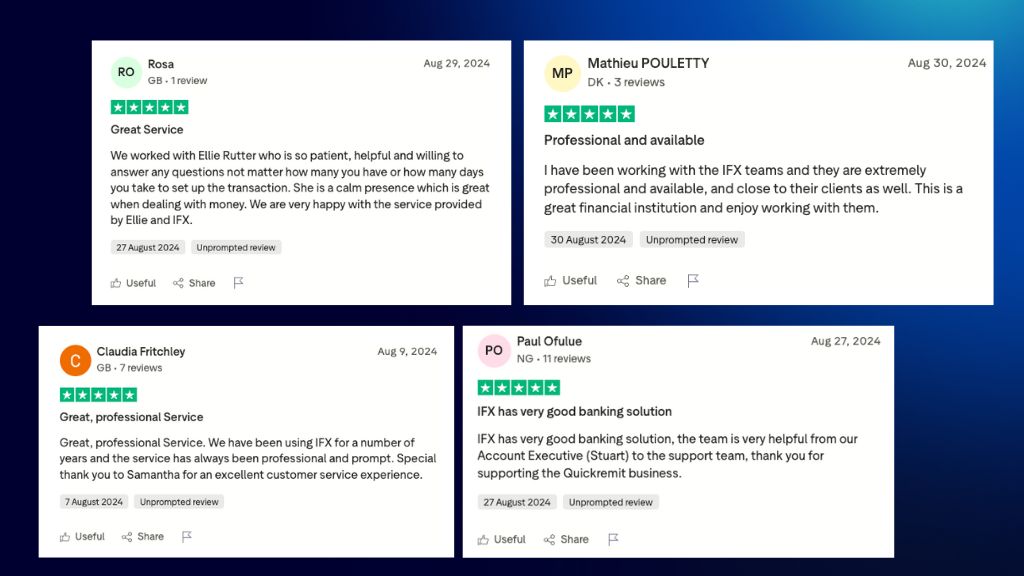
Some kind words from IFX Payments clients
All testimonials, reviews, opinions or case studies presented on our website may not be indicative of all customers. Results may vary and customers agree to proceed at their own risk.
How an ecommerce company cut FX costs and sped up payments with IFX
A small business selling globally on Amazon made regular supplier payments to China and received revenue from international sales. Two major issues were holding the company back.
- Incoming payments from the company’s existing provider often arrived late, taking four to five days, with no clear explanation.
- High FX costs and rate fluctuations were cutting into their margins, sometimes leaving them barely breaking even.
Using deliverable forward contracts, the company was able to lock in stable FX rates for supplier payments, saving them money and providing more predictability and control over payment costs. We also improved the visibility of their cross-border payments via our ibanq dashboard, which provides reporting capabilities.
Ultimately, by partnering with IFX, the ecommerce company was able to cut transaction fees, improve cash flow, and focus on growth.
Choose an international payments solution designed for SMEs
While lots of providers support international payments, only a few were built with SMEs in mind.
Features like multi-currency IBANs, bulk payments, and efficient onboarding are ideal for simplifying global business operations. But access to an account manager, who knows your name and your business, who equally wants to make your experience as smooth as possible, and will proactively keep you informed of market updates – that’s a unique offering you’ll only find with specialised providers.
If you’re an SME wanting to simplify your international payments, IFX can help with a tailored solution. Book a call with us today.
The contents of this article do not constitute financial advice and are provided for general information purposes only. Links to third-party websites are included for convenience only, and IFX Payments holds no responsibility for the content, services, products, or materials on those sites.