
Paying international contractors is different from paying employees and suppliers. There are distinct compliance obligations and payment timing is driven by invoices rather than pay runs. It’s important to know how to pay international contractors. Getting it wrong can lead to tax penalties or damaged working relationships.
Finance teams managing a growing contractor base can find their existing processes struggling. This guide is for you whether you are paying international contractors for the first time or improving an unwieldy process.
It covers compliance requirements, how the payment process works, and how to manage currency fluctuation on variable invoice payments.
Requirements can differ again for paying employees or suppliers overseas. Our guides on paying international employees and paying international suppliers cover each in detail.
Contractor vs employee: What it means for international payments
The legal distinction between a contractor and an employee is one of the most important concepts in workforce management. It determines your tax obligations, your payment process, and your legal exposure in every country where you engage workers.
An employee works under a contract of employment and is integrated into your organisation. They are entitled to statutory protections including paid leave, notice periods, and social security coverage in many countries. The employer is responsible for withholding income tax and making statutory contributions on their behalf.
A contractor, by contrast, works under a contract for services. They deliver a specific output or service, typically invoice for their work, and are generally responsible for their own tax affairs. The engaging business is not normally required to withhold income tax. Exceptions exist in certain jurisdictions and depend on how the relationship operates in practice.
Why misclassification is a serious risk
Misclassification occurs when a worker is treated as a contractor, but the working relationship more closely resembles employment. Tax authorities in most countries take misclassification seriously. The penalties for businesses falling foul of this can include back-payment of tax, interest, and fines.
In the UK, the IR35 legislation, or off-payroll working rules, determines whether a contractor should be treated as an employee for tax purposes. Since 2021, medium and large businesses are responsible for making this determination before engaging a contractor, where the contractor works through an intermediary such as a personal service company.
HMRC provides a free online tool called CEST (Check Employment Status for Tax) to help businesses make this assessment. Further guidance on the off-payroll working rules is available online.
Other countries have equivalent frameworks, but the specific rules vary by country. However, the underlying principle is consistent. If a worker functions as an employee, tax authorities are likely to treat them as one.
Compliance requirements for paying international contractors
Compliance for contractor payments is less prescriptive than for employees, but it is not absent. The obligations vary by country, the nature of the services provided, and in some cases by the value of the payment.
Withholding tax on international contractor payments
In some jurisdictions, businesses are required to withhold a portion of contractor payments and remit it to the local tax authority. This is known as withholding tax. It applies most commonly to non-resident contractors receiving income from a source in the withholding country.
In the UK, this only occurs if the payments are made for interest or royalties.
Whether or not withholding tax applies to your specific payments is a legal and tax question. Seek specialist advice for each jurisdiction where you engage contractors.
Contractor tax reporting obligations for international payments
Several countries require businesses to report payments made to contractors to the relevant tax authority, even where no withholding applies. These reporting obligations exist to help tax authorities verify that contractors are declaring their income correctly.
The requirements vary in scope and format. In the UK, businesses that engage contractors through personal service companies may have reporting obligations under the off-payroll working rules.
The European Union does not have a single unified reporting framework for contractor payments, but individual member states have their own requirements.
VAT and indirect tax considerations
When paying contractors based outside your country, indirect tax such as VAT (Value Added Tax) can introduce additional complexity. In a UK business-to-business context, payments to overseas contractors are often subject to the reverse charge mechanism. Under this mechanism, the recipient accounts for VAT rather than the supplier.
The VAT treatment of contractor payments depends on where the contractor is based, the nature of the services, and the VAT registration status of both parties. If your business is VAT-registered and engaging with international contractors, it is worth confirming the correct VAT treatment for each arrangement.
How to pay international contractors step by step
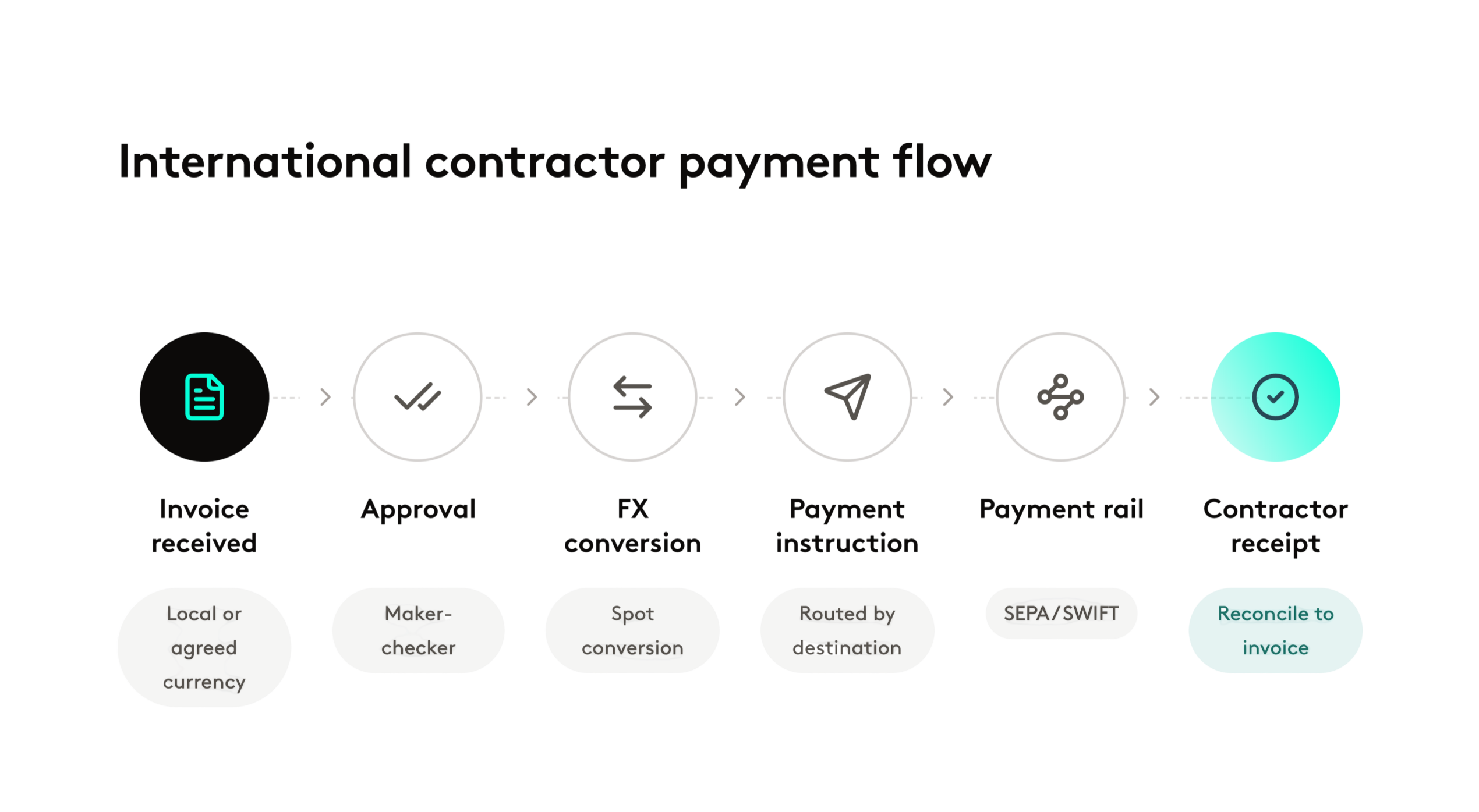
The operational flow for paying international contractors is invoice-driven rather than cycle-driven. This creates a different set of challenges from employee payroll, where the timing and amounts are predictable. With contractors, both can vary significantly from month to month.
Step 1: Invoice receipt and approval
A contractor submits an invoice for completed work. The invoice may be in their local currency or in a currency agreed at the outset of the engagement. Your finance or accounts payable team reviews it against the agreed scope, rate, and payment terms, then approves it for payment.
Document the approval process and ensure each step is attributable. For high-value payments in foreign currencies, a maker-checker approach is a standard governance requirement. This is where one person instructs/prepares and a second authorises the payment before release.
Step 2: Currency conversion
If the invoice is in a foreign currency, you need to convert from your home currency before or at the point of payment. Unlike employee payroll, contractor invoice amounts are often not confirmed until the invoice arrives. As a result, advance FX planning is harder for contractor payments than for payroll.
Spot conversion at the time of payment is the most common approach. For contractors on long-term retainers with predictable monthly amounts, forward planning becomes more practical.
Step 3: Payment instruction
Once the currency is ready, you instruct the payment to the contractor’s bank account. The payment route depends on the destination country and currency. Options include SEPA Credit Transfers for euro payments within Europe, local payment rails for markets where they are available, and SWIFT for broader international coverage.
SEPA (Single Euro Payments Area) is a network covering 41 European countries that enables fast, lower-cost euro transfers. SWIFT is a global financial messaging network that facilitates cross-border payments between banks worldwide. Each has different cost and settlement characteristics.
Step 4: Reconciliation against the invoice
Once payment is confirmed, match the transaction against the approved invoice. This means recording the following: the amount paid, the exchange rate applied, the settlement date, and the payment reference in your accounts payable system.
At low volumes this is straightforward. As your contractor base grows, manual reconciliation becomes a significant time burden. A payment provider that produces exportable, reference-level transaction data makes this process much more manageable.
Comparing payment methods by coverage, speed, and cost
| Payment method | Coverage | Speed | Cost | Suitable for |
|---|---|---|---|---|
| SEPA Credit Transfer | 41 European countries (EUR only) | Same or next business day | Low | Euro contractor payments within Europe |
| Local payment rails | Varies by country | Same day in many markets | Low to moderate | High-frequency payments in supported markets |
| SWIFT | Global | One to five business days | Moderate to high. Correspondent fees may apply. | Markets without local rail access |
Settlement times and costs vary by provider, corridor, and the currencies involved. Confirm the specifics with your payment provider for the markets relevant to your contractor base.
Managing FX and currency risk for contractor payments
Contractor FX risk is one of the more difficult aspects of international payment management. Unlike employee payroll, where amounts and pay dates are fixed, contractor invoices vary in both timing and value. This limits the scope for more structured planning and makes cost forecasting harder.
The spot conversion default and its limitations for contractor payments
Most businesses pay international contractors at the spot rate on or around the payment date. The spot rate is the current exchange rate at the time of conversion. This is the simplest approach and suits payments that are irregular in timing or amount.
The limitation is that spot conversion exposes you to short-term rate movements. A contractor paid in a volatile currency can produce meaningfully different costs from one month to the next. This is true even when the contractor invoices the same amount in their local currency each time. Over a large contractor base, this variability compounds.
Forward planning for retainer-based contractors
For contractors engaged on predictable monthly retainers, the FX planning options are closer to those available for payroll. If you know the invoice amount and currency three to four weeks ahead, you have more room to act. You can convert earlier at a spot rate of your choosing or use a deliverable forward contract to lock in a rate for a future date.
A deliverable forward contract is an agreement to convert a specified amount of currency at a pre-agreed rate on a future date. For retainer contractors where the amount and timing are consistent, this can provide useful cost certainty. Whether this is appropriate for your business depends on your specific circumstances and treasury policy. Seek independent professional guidance where needed.
Holding currency balances
If you pay multiple contractors in the same currency, holding a balance in that currency between payment runs gives you more control. It reduces the number of individual spot conversions and can lower your average conversion cost over time.
Multi-Currency Business Accounts allow you to hold, receive, and pay out in multiple currencies from a single platform. This is particularly useful for businesses where several contractors may invoice in the same currency.
Common mistakes when paying international contractors
The most common problems with international contractor payments are avoidable. They tend to stem from processes that have not kept pace with the scale or geographic spread of the contractor base.
Misclassifying contractors as suppliers
Contractor and supplier payments often flow through the same accounts payable process, but they carry different compliance obligations. A supplier relationship is typically for goods or recurring services from a business entity. A contractor relationship involves an individual providing personal services.
Treating contractor payments as routine supplier payments can create several risks. You may miss withholding tax obligations, fail to make the necessary employment status determination under IR35 or equivalent frameworks, or create an audit trail that does not reflect the true nature of the relationship.
Poor invoice controls
Contractors submitting invoices by email are particularly prone to duplicate payment risk. The same invoice, resubmitted with a different date or reference number, can pass through an informal approval process and be paid twice. This is more common than most finance teams expect and can be difficult to recover once paid.
A structured invoice approval process, with duplicate detection at the point of entry, significantly reduces this risk. Even a simple reference number register maintained outside the payment system helps.
Missing withholding tax obligations
Withholding tax on international contractor payments is easy to overlook, particularly for businesses that are expanding into new markets. Unlike employment tax, which is built into payroll systems, withholding on contractor payments typically requires a manual step.
Missing a withholding obligation can result in back-payment of the tax and interest on the unpaid amount. In some jurisdictions, penalties apply to the engaging business rather than the contractor. A brief compliance review for each new jurisdiction before you make your first payment is time well spent.
Inadequate beneficiary data
Payments sent to an incorrect IBAN or with a mismatched beneficiary name will either be rejected or credited to the wrong account. Verify contractor banking details before the first payment and establish a process for capturing updates when contractors change accounts.
IBAN or International Bank Account Number is a standardised format used across many countries to identify bank accounts for international transfers. Not all countries use the IBAN format. Payments to contractors in markets such as the US, Canada, or Australia will need local account details such as routing or BSB numbers instead.
No audit trail across the contractor payment lifecycle
An international contractor payment should be traceable from invoice receipt through approval, currency conversion, payment instruction, and settlement. Each step should be attributable to a named individual and timestamped.
Businesses managing this across email, spreadsheets, and banking portals often find, during an audit, that they cannot reconstruct the complete payment chain. Build a clean audit trail into the process from the outset. After all, this is much easier than recreating it retrospectively.
What to look for in an international contractor payment provider
The requirements for paying international contractors at scale differ from those for payroll. The key differences are the variability of timing and amounts, the need for strong invoice-to-payment matching, and the geographic spread of a typical contractor base.
Currency coverage and local rail access
Check that your provider can pay out in the currencies your contractors invoice in, through local payment rails where available. A provider that routes all international payments through SWIFT will be slower and more expensive than one with direct access to local rails in your key markets.
Beneficiary management
As your contractor base grows, managing beneficiary records becomes a meaningful operational task. Look for a provider that supports bulk beneficiary uploads, version control for updated banking details, and an audit trail for every change. This is particularly important when onboarding contractors in new markets.
Transparent FX pricing on variable amounts
Ask your provider to confirm the margin applied to each conversion. For contractor payments where invoice amounts vary, the true cost of FX can be difficult to track if pricing is not transparent. A provider that states the margin clearly at the point of instruction makes it straightforward to monitor and forecast your FX costs.
Payment controls and approval workflows
Contractor payments are often high-value and require a clear approval chain. Your payment platform should support maker-checker workflows and role-based access controls. Together, this ensures the right people have visibility and authority at each step and creates a clear record of who approved what and when.
Reconciliation data
Confirm that your provider produces structured, exportable transaction data for every payment. This should include the exchange rate applied, the settlement date, the payment reference, and the beneficiary details. Data in this format can be matched against approved invoices in your accounts payable system without manual intervention.
Related guides in this series
If you also pay employees or suppliers internationally, the compliance and operational requirements are different in each case. We’ve written about other scenarios here:
- Paying international employees: covers employment structures, PAYE, social security obligations, and how to manage employee payroll across multiple currencies.
- Paying international suppliers: covers accounts payable workflows, supplier onboarding, bulk payment processes, and the compliance requirements for business-to-business international payments.
- International payroll payments: the parent guide covering the full picture across employees, contractors, and suppliers.
Getting the foundations right
Paying international contractors well is a sign of a mature finance operation. The compliance requirements are manageable, and the payment infrastructure available today makes it straightforward to pay contractors in most currencies.
Maybe your contractor base has grown beyond what your current process can handle comfortably. Or maybe you are expanding into new markets where the compliance picture is less familiar. Either way it is worth taking the time to review your setup. Getting the foundations right means fewer problems as you scale.
At IFX Payments, we work with businesses managing cross-border contractor payments across multiple currencies and jurisdictions. IFX (UK) Ltd is authorised and regulated by the FCA for the issuing of electronic money.
Through our ibanq platform, we provide Multi-Currency Accounts, transparent FX pricing, and bulk payment processing, alongside the approval controls and reconciliation data that finance teams need to manage contractor payments at scale. If this is a growing part of your workload, we would be glad to talk through how we can help.
The contents of this article do not constitute financial advice and are provided for general information purposes only. Links to third-party websites are included for convenience only, and IFX Payments holds no responsibility for the content, services, products, or materials on those sites.