
Key takeaways
- Complexity grows with scale. Varied currencies, payment terms and bank details make manual processes unworkable as supplier numbers grow.
- A structured process keeps payments on track. Matching invoices to POs, approving, converting, paying and reconciling in a set order avoids late and incorrect payments.
- Your provider choice shapes cost and control. Look for local payment rails, transparent FX pricing, bulk payments, AP integration and approval controls.
Paying international suppliers is one of the highest-volume payment tasks most finance teams manage. Unlike the fixed cycles of employee payroll, supplier payments follow purchase orders, invoice terms, and delivery schedules. These vary across dozens or hundreds of supplier relationships at once.
The cost of getting this wrong is real. Late supplier payments damage trading relationships and can trigger penalty clauses. Opaque FX pricing can erode margins on every transaction without your realising. A manual payment process that works at 50 suppliers can cause all sorts of issues when you’re paying 500.
This guide covers how to pay international suppliers efficiently, and how to manage FX costs across variable volumes. It also covers your compliance obligations and what to look for in a payment provider.
If you also pay employees or contractors overseas, we have dedicated guides covering both. Our guide on paying international employees and our guide on paying international contractors cover each in detail.
Why paying international suppliers is operationally complex
Supplier payments look simpler than payroll on the surface. They carry no employment compliance obligations or tax withholding requirements in most cases. No statutory deadlines tie to an individual’s livelihood. In practice, however, supplier payments at scale create their own set of operational pressures.
Volume and variety
A business with 200 international suppliers could be paying in 30 currencies involving multiple banking relationships. Each supplier has its own payment terms, invoice format, and bank account structure.
Some suppliers require payment via SWIFT, while others use local payment rails. Certain currencies also carry additional compliance requirements.
At low volumes, the variety is manageable with manual processes. As supplier numbers grow, the manual overhead compounds quickly. A finance team processing 500 international supplier payments a month cannot do so efficiently without structured payment infrastructure.
Payment terms and cash flow timing
Supplier payment terms vary widely. Net 30, Net 60, and 90-day terms are common in international trade, alongside early payment discounts for prompt settlement. Managing these terms across a large supplier base requires clear visibility of what is due and when, across multiple currencies.
Late payment to suppliers can carry legal consequences as well damaging business relationships. In the UK, the Late Payment of Commercial Debts (Interest) Act 1998 gives suppliers the right to charge interest on overdue invoices. Finance teams need systems that surface upcoming payment obligations before they become overdue, not after.
The true cost of paying international suppliers
Most businesses know what they are paying their suppliers, but fewer know what it is costing them to make those payments. The true cost of international supplier payments includes the FX margin applied on each currency conversion, correspondent banking fees deducted in transit, and the staff time consumed by manual payment processing and reconciliation.
Take a business making 300 international payments a month at an average of £10,000 each. A 1.5 per cent FX margin on those payments amounts to £45,000 in monthly FX costs. Many businesses overlook this cost because it sits within the exchange rate rather than appearing as a separate fee.
Compliance requirements for paying international suppliers
Supplier payments carry fewer compliance obligations than employee or contractor payments in most jurisdictions. However, several requirements do apply and overlooking them creates financial and reputational risk.
They can include sanctions screening where payment providers screen payments against sanction lists before releasing. There are also Anti-money laundering (AML) obligations and VAT to consider, as well as additional compliance requirements, or transfer pricing rules, for paying suppliers that belong to the same group.
How to pay international suppliers step by step
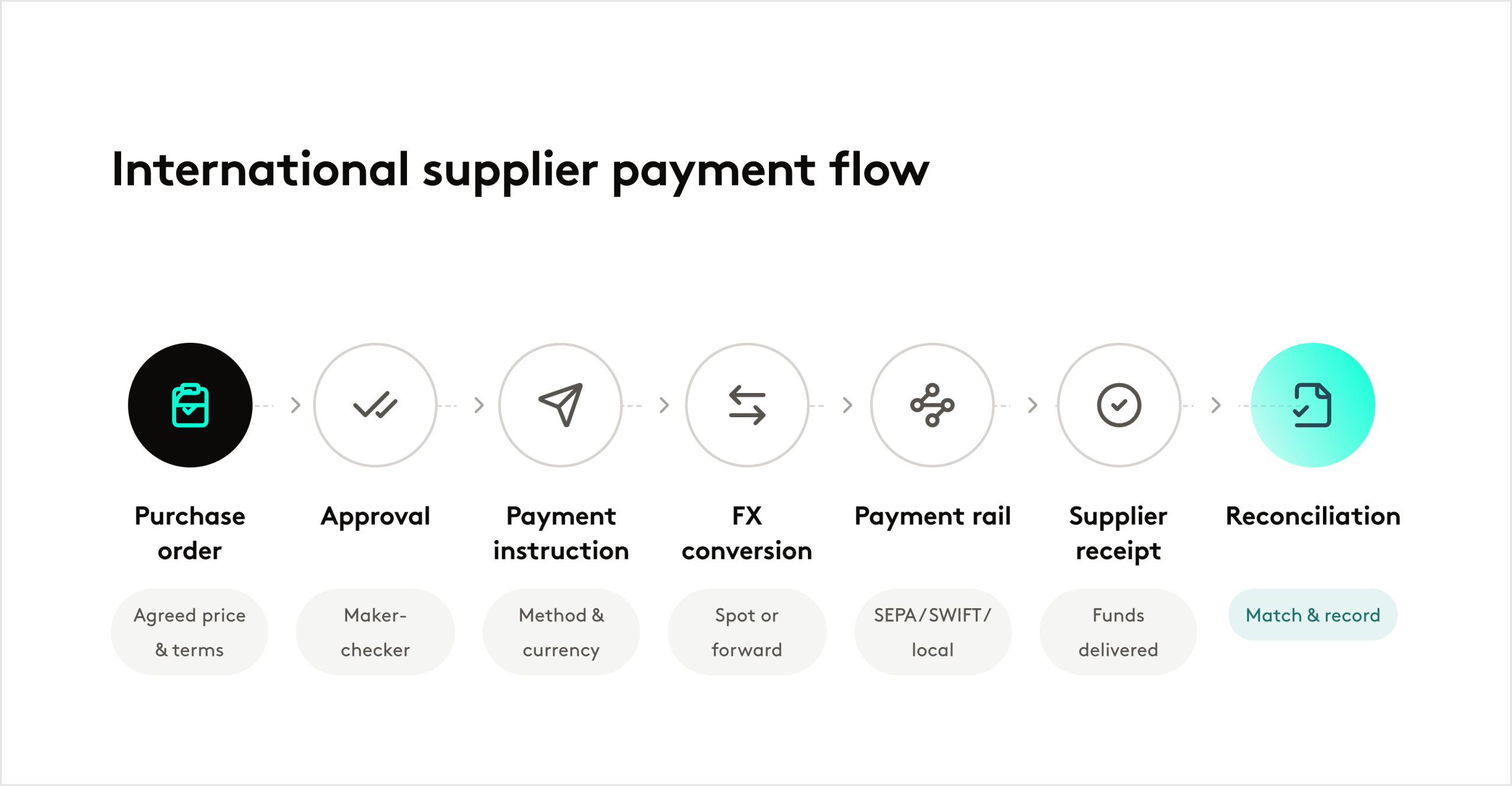
The operational flow for paying international suppliers shares some characteristics with paying international contractors but differs in important ways. Volumes are typically higher, payment terms are more structured, and the relationship between payment and goods or services received is more formal.
Step 1: Purchase order and invoice matching
A well-run accounts payable process starts before the invoice arrives. A purchase order (PO) is raised at the point a supplier relationship is engaged. It will capture the agreed price, currency, quantity, and payment terms. When the supplier’s invoice arrives, you match it against the PO.
Three-way matching compares the PO, the invoice, and the goods receipt note. It is the standard control for ensuring payment is only made for goods or services that were ordered and received. This step is often manual in smaller businesses and automated in larger ones through ERP (Enterprise Resource Planning) systems.
Step 2: Approval and payment instruction
Once an invoice is matched and approved, it is instructed for payment. For international payments, this means selecting the payment method, confirming the currency, and initiating the transfer. A maker-checker control is standard practice for high-value international transfers. This is when one person raises the payment and a second authorises it before release.
Payment terms determine when the payment should be released. A Net 30 invoice received on 1 January should be paid by 31 January. Managing this across hundreds of suppliers requires either a structured payment run schedule or an automated payment scheduling system.
Step 3: Currency conversion
If the supplier invoices in a foreign currency, conversion from your home currency happens either at the point of payment or in advance. Supplier payments are often less predictable in timing than payroll but more predictable than contractor invoices. Agreeing payment terms upfront helps with planning.
If you pay suppliers regularly in the same currency, consider holding a balance in that currency. It reduces the number of individual conversions and gives you more control over when you convert. For larger or less frequent payments, the FX strategy depends on your treasury policy and the volatility of the currencies involved.
Step 4: Payment execution
The payment is released through your payment provider using the appropriate payment method for the destination country and currency. The table below sets out the main options.
Comparing payment methods by coverage, speed, and cost
| Payment method | Coverage | Speed | Cost | Suitable for |
|---|---|---|---|---|
| SEPA Credit Transfer | 41 European countries (EUR only) | Same or next business day | Low | Euro supplier payments within Europe |
| SEPA Instant | Growing coverage across Europe | Seconds | Low to moderate | Time-sensitive euro payments where supported |
| Local payment rails | Varies by country | Same day in many markets | Low to moderate | High-volume payments in supported markets |
| SWIFT | Global | One to five business days | Moderate to high. Correspondent fees may apply. | Markets without local rail access |
Settlement times and costs vary by provider, corridor, and the currencies involved. For high-volume supplier payment programmes, the choice of payment method can have a meaningful impact on both cost and supplier experience.
Step 5: Reconciliation
Once payments are released, each transaction needs to be matched against the corresponding invoice in your AP system. To reconcile at scale, you need structured transaction data from your payment provider. This should include the payment reference, exchange rate, settlement date, and beneficiary details.
Without this data, reconciliation is a manual, time-consuming process. This creates end-of-month pressure and leaves errors undetected for longer than they should be.
Managing FX costs for international supplier payments
FX cost management is more important for supplier payments than for any other payment type covered in this guide. Higher volumes and greater frequency mean the cumulative impact of a poorly managed FX programme is significant. A systematic approach to supplier FX is one of the highest-return improvements a finance team can make.
Understanding the true cost of FX when paying international suppliers
When you convert currency to pay a supplier, the cost is not always visible as a line item. Most payment providers and traditional banking providers apply a margin to the exchange rate. This means you convert at a rate that is less favourable than the rate at which the provider traded. The difference is the provider’s revenue on the transaction.
A margin of 1.5 per cent sounds modest. But on a monthly programme of £500,000 in foreign currency conversions, that is £7,500 per month or £90,000 per year. Most absorb these costs into general payment costs without realising. Switching to a provider that provides up-front costs and some room for negotiation is going to help you plan and potentially make some savings.
Spot versus forward contracts for paying international suppliers
Most supplier payments are made at the spot rate, meaning you convert at the rate available at the time of payment. For suppliers paid regularly, in predictable amounts, there is a case for using forward contracts to lock in rates ahead of payment dates.
A deliverable forward contract is an agreement to convert a set amount of currency at a pre-agreed rate on a future date to pay for goods or services. For a business with significant recurring supplier payments in volatile currencies, forward contracts can provide cost predictability. Whether they are appropriate depends on your treasury policy and risk appetite. Seek independent professional guidance where needed.
Holding multi-currency balances
If you pay multiple suppliers in the same currency, holding a balance in that currency avoids repeated conversions and reduces your exposure to short-term rate movements. A multi-currency account lets you receive funds, hold them, and pay suppliers in the same currency without converting back and forth.
This is particularly useful for businesses importing from a single region where most suppliers invoice in the same currency. Holding euros or US dollars and paying suppliers directly from that balance simplifies both the FX process and the reconciliation.
Bulk payment runs and FX efficiency
Processing supplier payments in bulk rather than individually has FX advantages as well as operational ones. A single conversion of £200,000 to USD to fund a batch of supplier payments is typically more efficient than 20 individual conversions of £10,000 each. Bulk conversions give you a single rate to track and a single reconciliation entry. Your FX provider may also offer better pricing on larger transaction sizes.
This requires a payment platform that supports bulk file uploads and mass payment processing. If you are instructing payments individually through a banking portal, the operational and FX efficiency gains from batch processing are not accessible.
Common mistakes when paying international suppliers
The most common problems in international supplier payment operations are predictable. They tend to emerge as supplier numbers grow and the informal processes built for a smaller supplier base stop working.
Poor supplier onboarding for international payments
The quality of your supplier payment data determines the reliability of your payments. Incorrect IBANs, mismatched beneficiary names, outdated bank details, and missing SWIFT codes all cause payment failures and delays.
Supplier onboarding is the process of capturing and verifying banking details before the first payment.
A structured onboarding process, with a confirmation step where new banking details are verified before being added to your payment system, reduces the risk of misdirected payments. For first-time payments above a certain value, call-back verification is standard practice. This is where a team member confirms new banking details directly with the supplier by phone.
No visibility of international supplier payment costs
Finance teams that cannot see the FX margin applied to each conversion cannot manage it. If your payment provider does not disclose the rate margin at the point of instruction, or if FX costs are rolled into a blended payment fee, you are operating without cost visibility on a significant line item.
Ask your provider to confirm the margin on each conversion separately from any transaction fee. If they are unwilling to do this, that is a signal worth taking seriously. Transparent FX pricing is a baseline expectation for any specialist payment provider.
Fragmented payment infrastructure
Businesses that grow internationally often end up with supplier payments split across multiple banking relationships, each covering a different region or currency. This fragmentation creates reconciliation complexity and makes it harder to negotiate better FX terms. It also increases the risk of payments falling through the gaps between systems.
Consolidating supplier payments into a single platform, or as few as operationally justified, reduces manual data movement and gives finance teams a single view of all outgoing payments. This does not always mean switching providers immediately. It can mean starting with the highest-volume corridors and consolidating incrementally.
Manual payment runs at scale
Instructing supplier payments individually through a banking portal is practical for a handful of payments. At 100 or more international monthly payments, it could become an operational burden and potentially a source of keying errors. A payment platform that supports bulk file upload, where a single file containing all payment instructions is uploaded and processed simultaneously, removes both problems.
Automation of recurring supplier payments, where payment terms and beneficiary details are held in the system and payments are scheduled automatically, further reduces manual effort and the risk of missed payment deadlines.
Treating international supplier payment reconciliation as an end-of-month task
Reconciling supplier payments after the fact concentrates significant effort at month end. Errors, duplicate payments, and FX discrepancies accumulate rather than being caught immediately. A payment provider that produces structured, exportable transaction data at the point of execution makes real-time or near-real-time reconciliation practical.
Integrating payment data directly into your ERP or accounting system removes the reconciliation bottleneck. It also reduces the risk of errors introduced by manual data re-entry.
Choosing a payment provider for paying international suppliers
The requirements for paying international suppliers at scale are more demanding than for employees or contractors. Volumes are higher, the range of currencies and corridors is wider, and the operational efficiency gains from getting the provider choice right are larger.
Currency coverage and local payment rails
Confirm that your provider can pay out in the currencies your suppliers invoice in. A provider with direct access to local rails in your key supplier markets will be faster and more cost-effective than one routing all payments through SWIFT. For businesses with significant supplier bases in Europe, Asia, or the Middle East, local rail coverage is a differentiator.
Transparent FX pricing
For supplier payments, FX pricing transparency is more important than for any other payment type. Ask any prospective provider to confirm the margin applied to each conversion, stated separately from transaction fees. The ability to see the rate at the point of instruction, rather than discovering it in reconciliation, is a basic requirement for managing your FX programme effectively.
Bulk payment and mass payment capability
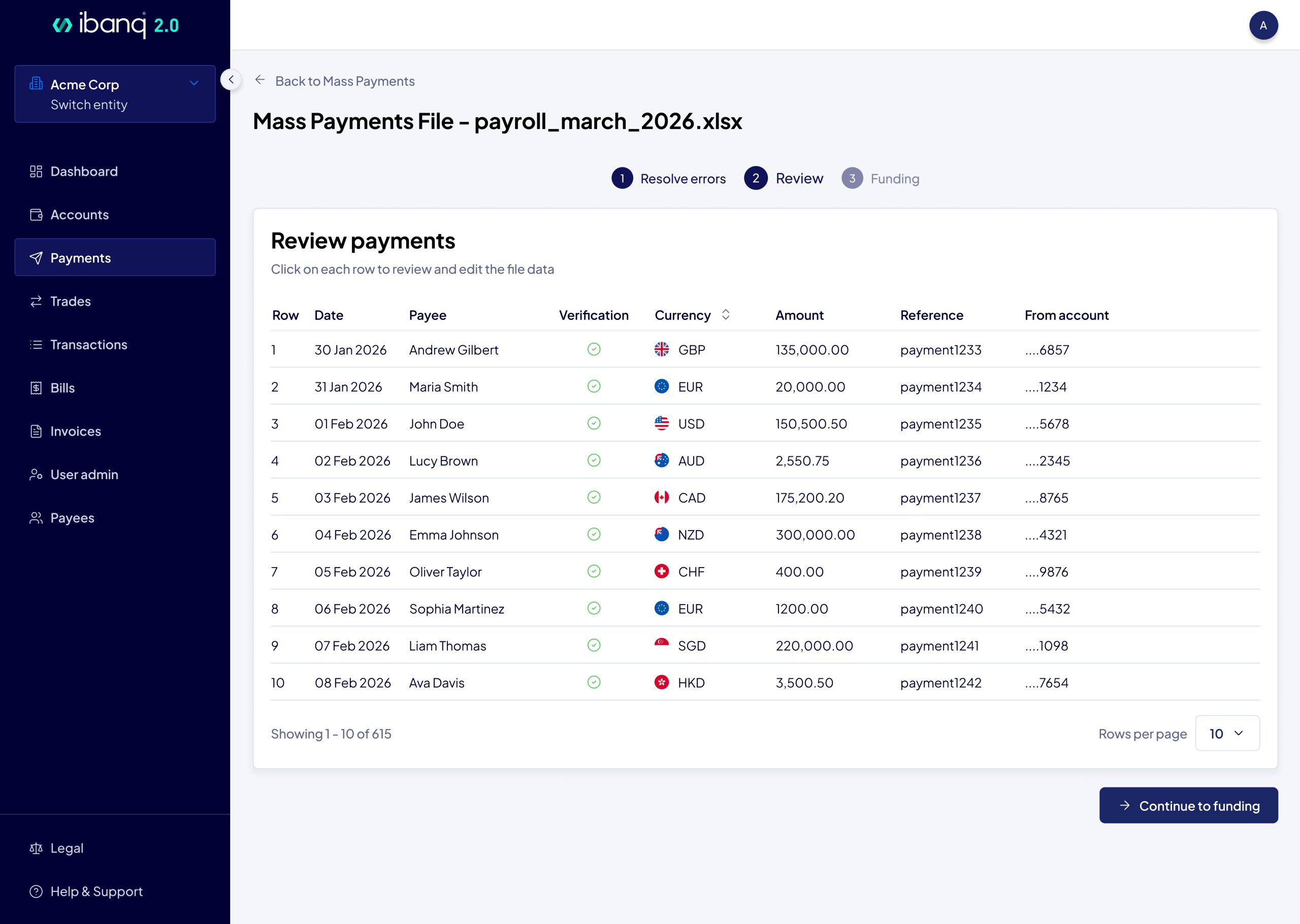
For businesses with significant supplier bases, bulk payment processing is non-negotiable. Your provider must handle large batches of payment instructions from a single file upload. Look for a platform that supports bulk file ingestion in standard formats and provides real-time payment status updates. It should also handle exceptions cleanly without manual intervention for each failed payment.
Supplier onboarding and beneficiary management
Managing a large supplier beneficiary list requires a platform that supports bulk uploads, version control for updated banking details, and a clear audit trail for every change. Supplier banking details change more frequently than most finance teams expect. A provider that makes it easy to update and verify beneficiary information reduces the risk of misdirected payments.
Integration with your AP system
The most efficient supplier payment operations integrate the payment platform directly with the AP or ERP system. This allows approved invoices to flow through to payment instruction without manual re-entry. API (Application Programming Interface) access is typically how this integration works. An API is a connection point that allows two software systems to exchange data automatically.
Not every business needs full AP integration. But for businesses processing more than a few hundred international supplier payments per month, the operational savings from automating the data flow between systems is significant.
Payment controls and audit readiness
Supplier payments are high-value and frequent. Maker-checker approval workflows, role-based access controls, and a complete payment audit trail are governance requirements. Any provider that cannot demonstrate these clearly during a sales conversation should not be handling your supplier payment programme.
IFX Payments is an FCA-regulated Electronic Money Institution (EMI), working with businesses managing high-volume international supplier payments across multiple currencies and corridors. Through our ibanq platform, we provide Multi-Currency Accounts, transparent FX pricing, and bulk payment processing. Users receive approval controls and reconciliation data that finance teams need to manage supplier payments at scale. If international supplier payments are a growing challenge for your business, we would be glad to talk through how we can help.
Sorting out your international suppliers pay run reflects well on your business. The complexity is real, particularly at scale, but it is also well understood. The payment infrastructure and FX tools available today make it possible to pay suppliers in most currencies, on time, with full cost visibility and a clean audit trail.
If your supplier payment programme has outgrown your current process, it is worth reviewing your approach. The gains from getting this right compound with every payment run.
The contents of this article do not constitute financial advice and are provided for general information purposes only. Links to third-party websites are included for convenience only, and IFX Payments holds no responsibility for the content, services, products, or materials on those sites.