
Managing international payroll payments has become a core operational responsibility for any business with an internationally distributed workforce or supply chain. Yet most finance teams have the following infrastructure. A combination of systems, banking relationships, and manual processes that were never designed to work together.
You might be:
- Paying employees in multiple countries
- Settling invoices with overseas contractors
- Managing supplier payments across different currencies
In each case, the complexity grows with every new market you enter.
This guide covers the full picture. It explains why international payroll payments are difficult, where traditional banking providers fall short, and what to look for in a specialist payment solution. There is a dedicated section on managing FX risk within your payroll cycle. And you will find links to guides for each recipient type, so you can go deeper where it matters most.
Why international payroll payments are operationally complex
International payroll sounds like a single process. In practice, there are several parallel workflows running simultaneously. Many of these have different timing, data requirements, compliance obligations, and banking instructions.
This is the result of infrastructure built for domestic transactions. It has since been stretched to accommodate something it was never designed for.
The multi-system problem
A typical finance team managing cross-border payroll may use a combination of tools. A domestic payroll system to calculate net pay, manual FX conversion, and one or more banking portals to instruct payments. Supplier and contractor payments often run through accounts payable (AP) entirely, with a separate approval chain and banking setup.
None of these systems communicate natively. Data moves between them manually, through file exports or spreadsheet uploads.
As well as that, every manual step introduces the possibility of error. At low volumes, this is manageable. At scale, it becomes a significant operational risk.
The three recipient types and why they require different treatment
One of the most common mistakes finance teams make is applying a single payment process to all three recipient types. Employees, contractors, and suppliers have different compliance requirements, payment timing patterns, and FX considerations. Understanding these differences is the first step to building a process that works across all of them.
Comparing recipient types by payment mechanism and compliance
| Recipient type | Typical payment mechanism | FX trigger point | Key compliance consideration | Volume characteristic |
|---|---|---|---|---|
| Employees | Payroll run | Fixed pay date | Employment law, local tax obligations | Predictable, recurring |
| Contractors | Invoice-led | On invoice approval | Withholding tax, IR35 (UK) | Variable timing and amount |
| Suppliers | Accounts payable | On agreed payment terms | AML screening, sanctions checks | High volume, variable amount |
A single payment process rarely works cleanly across all three recipient types. Most operational failures (late payments, reconciliation discrepancies, compliance gaps) stem from applying one approach to all of them. The sections that follow address this across every stage of the payment lifecycle.
The hidden costs of using a traditional bank for cross-border payroll
Most businesses manage international payroll through a traditional banking provider. It is often the path of least resistance when a business first expands internationally. The limitations only become visible once payment volumes grow, currencies multiply, and the cost of inefficiency becomes measurable.
FX spread opacity and what it costs at scale
When a bank converts funds from one currency to another, it applies a spread. This is the difference between the rate it trades at and the rate it offers you. Instructors rarely disclose this spread clearly at the point of instruction.
You instruct the payment, the bank applies the rate it has decided. The true cost only becomes visible during reconciliation.
For businesses converting large payroll amounts across many currencies, even a one or two per cent spread adds up. It also creates a budgeting problem. If you cannot see the rate at the time of instruction, you cannot forecast your payroll costs with accuracy.
The FCA has highlighted poor practice in this area. Some firms reviewed as part of the Consumer Duty regulation did not provide “clear disclosure on the overall cost of the transaction, including any markups that may be applied to the exchange rate.”
Batch processing, cut-off times, and the late payment risk
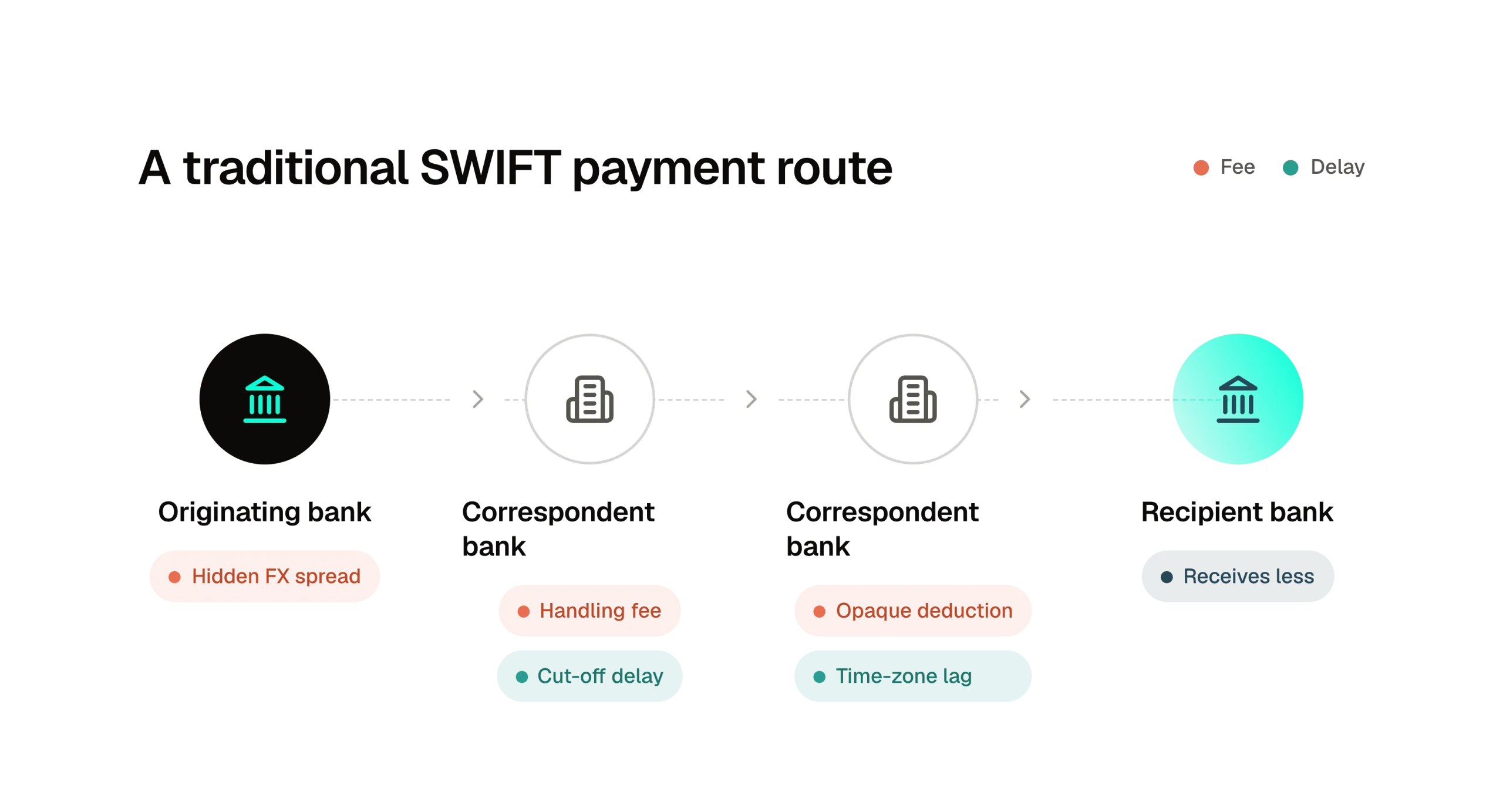
Traditional banking providers operate on batch settlement windows. A payment instructed after the daily cut-off time moves to the next business day. For international payments, this can mean a longer delay. This happens while the instruction passes through correspondent banks in different time zones.
For payroll, a missed cut-off can carry legal liability. In many jurisdictions, late salary payment is the employer’s responsibility.
Finance teams operating across multiple time zones need to maintain a precise understanding of each banking cut-off and build buffer time into every pay cycle. This is manageable with one or two payment corridors. It becomes genuinely difficult at scale.
The correspondent banking problem
Most international payments are routed through the SWIFT network, which stands for the Society for Worldwide Interbank Financial Telecommunication. SWIFT is a global messaging system that banks use to instruct cross-border payments. It does not move money directly, but facilitates the instructions between financial institutions.
When a payment travels through SWIFT, it passes through one or more correspondent banks, each of which may deduct a handling fee. The recipient receives less than the amount instructed. From a reconciliation perspective, this creates discrepancies that finance teams then have to investigate. Often there is no clear visibility of where the deduction occurred or what its basis was.
Where fintech providers help and where they fall short
The first generation of business-focused fintech payment providers addressed several genuine problems with traditional banking. That included opaque FX pricing, slow transfer speeds, and cumbersome user interfaces. For businesses with straightforward payment needs, these improvements will have made a difference.
However, as payment volumes grow and recipient types diversify, the limitations of simpler fintech platforms become apparent. The table below sets out the key capability gaps that emerge when finance teams attempt to scale their international payment operations beyond a basic level.
Operational needs: consumer/SME fintech vs specialist payments provider
| Operational need | Mass-market fintech | Specialist payments provider |
|---|---|---|
| 30+ currency coverage | Partial | Yes |
| Bulk / mass payment processing | Limited | Yes |
| Forward contracts for rate certainty | Rarely | Yes |
| Multi-entity sub-account structures | Rarely | Yes |
| Maker-checker approval workflows | Limited | Yes |
| Structured reconciliation data | Basic | Yes |
| API integration for payment automation | Yes | Yes |
Admittedly, for businesses making a small number of international payments in common currencies, a mass-market fintech provider may be adequate. The capability gaps in the table above become significant at higher volumes, or across more currencies. It might also be where internal governance requirements demand audit-ready payment controls.
What to look for in an international payroll payment provider
Selecting a payment provider for international payroll is not purely a cost decision. The operational and compliance implications of getting this wrong are significant. The following criteria reflect what finance teams at scale consistently identify as the factors that matter most in practice.
Currency coverage and payment corridors
The number of currencies a provider can receive, hold, and pay out will determine if it can support your business. As you expand internationally, this becomes even more important. SWIFT coverage is not sufficient on its own. For payments into markets such as South-East Asia, Sub-Saharan Africa, or Latin America, access to local payment rails can add further challenges.
Ask any prospective provider which corridors they support and what the settlement timelines are for each. Confirm whether they route through local rails or SWIFT for the markets that matter most to your business.
FX tools and rate certainty
A provider that offers only spot FX transactions leaves your payroll costs exposed to rate movements. The risk sits in the gap between when you calculate net pay and when you actually convert and send.
For finance teams managing payroll in volatile currencies, using deliverable forward contracts can make a difference to budget certainty. A forward contract is an agreement to convert currency at a fixed rate on a future date, which mitigates short-term rate exposure from the payroll cycle.
Admittedly, this is not a financial advisory recommendation. Whether forward contracts suit your business depends on your circumstances. You should seek independent guidance if needed.
Platform capability for scale
A provider’s ability to process bulk payments is non-negotiable for businesses with large internationally distributed workforces or supplier bases. Equally important is real-time or near-real-time payment status visibility. This way exceptions can be identified and resolved before they become late payments.
Ideally you want structured data exports that can be reconciled against your Enterprise Resource Planning (ERP) or accounting system without manual intervention. The reconciliation burden of a high-volume international payment programme can be substantial. A provider that produces clean, reference-level transaction data at the point of execution reduces this burden considerably.
Controls, permissions, and audit readiness
Any provider handling high-value payments should offer maker-checker controls. One user creates the payment. Another user must approve it before release.
Role-based access permissions allow you to define what each user can see and do within the platform. Most finance and audit functions expect these as standard governance requirements.
A complete audit trail should also be available without additional effort. If a provider cannot demonstrate this clearly during a sales conversation, it is unlikely to be an adequate solution.
A specialist payments provider such as IFX Payments operates in this space. IFX Payments is an FCA-regulated Electronic Money Institution (EMI). Through ibanq, businesses can manage multi-currency accounts, initiate bulk payments, and access FX tools, from a single dashboard. You can learn more about IFX Payments’ cross-border payments platform on our website.
Managing FX risk in international payroll
Companies often overlook currency risk in international payroll. That is until it shows up as an unexplained cost variance come the end of the month. Foreign exchange risk is one of the least visible costs in this area, and one of the most consequential. Finance teams that treat FX as an afterthought tend to absorb avoidable variances every cycle.
The payroll FX timing problem
There is a gap between when payroll is calculated and when currency is converted and payments are sent. The company fixes net pay in local currency terms. The local currency cost to the business isn’t fixed until the conversion actually takes place.
In stable currency pairs, this gap may be immaterial. In more volatile pairs, movements between calculation and conversion can lead to significant cost variances from month to month. For example, businesses may fund payroll in South African rand, Brazilian real, or Turkish lira, using GBP or USD.
Spot contracts versus forward contracts for payroll
A spot contract is the simplest form of FX transaction. You convert at the rate available at the time of instruction. Settlement should happen immediately or within two business days. Use these when you feel comfortable absorbing short-term rate movements.
A forward contract is an agreement to exchange a specified amount of currency at a pre-agreed rate on a future date. When it comes to payroll, we know the amounts and timing well in advance. That makes forward contracts well suited to locking in the cost of your next pay cycle at the point of calculation. As a result, you’re significantly reducing the impact of short-term rate exposure.
Which product you use depends on your specific circumstances, risk appetite, and treasury policy. This article does not constitute advice on that decision. Seek independent professional guidance where needed.
Practical steps to reduce FX exposure in payroll
- Calculate your foreign currency payroll obligations as early in the cycle as possible, to maximise the window available for FX planning.
- Consider holding balances in the currencies you pay out in regularly, to reduce the frequency and urgency of spot conversions.
- Set up rate alerts with your payment provider so that you are informed when rates reach levels that are favourable for conversion.
- Maintain a clear record of the rate applied to each conversion, the date it was executed, and the amount converted, as part of your standard reconciliation process.
Building an efficient international payment process
Operational efficiency in international payroll is not achieved through a single change. It is the product of decisions made at the process design level: how payment flows are structured, where data moves between systems, and how exceptions are managed when they occur.
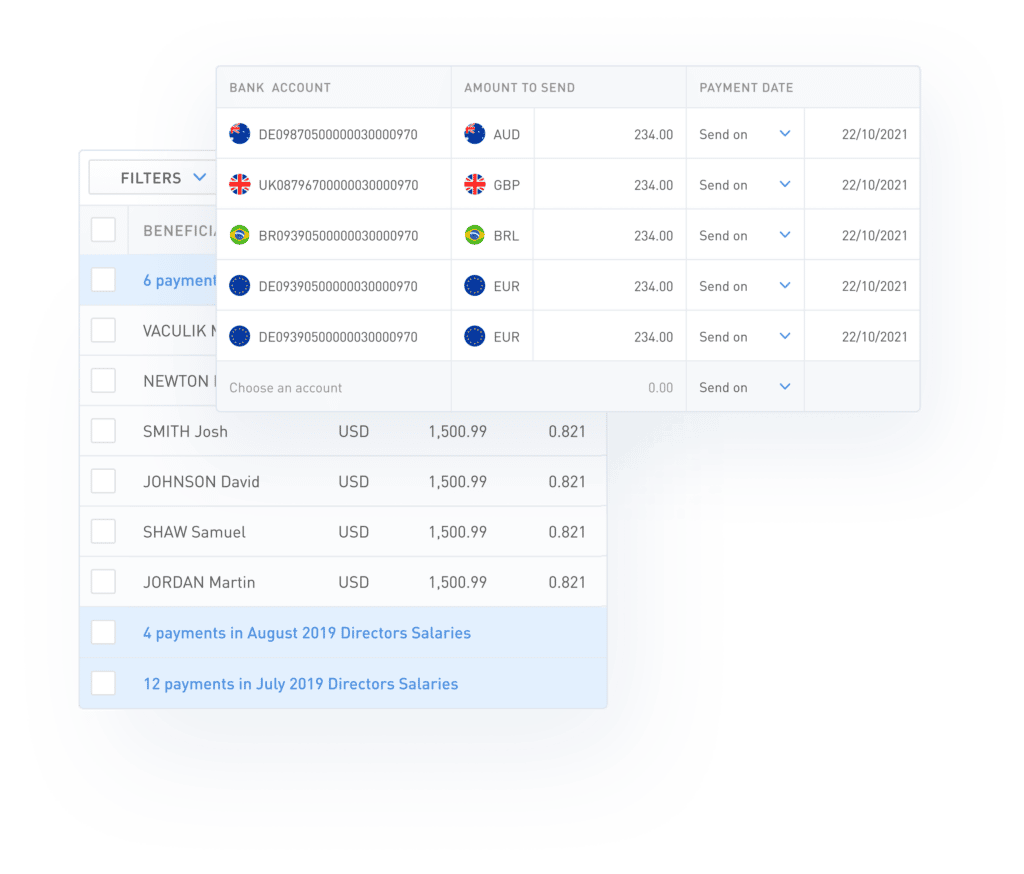
A bulk payment solution can automate cumbersome tasks
Centralise where possible
Running international payments through multiple banking relationships and platforms creates a fragmented data environment that is difficult to oversee and expensive to reconcile. Consolidating payment flows into a single platform reduces manual data movement, improves visibility, and simplifies the reconciliation process at month end.
Consolidation is not always immediately achievable, particularly for businesses that have grown internationally through acquisition and carry legacy banking relationships in multiple jurisdictions. In those cases, a practical approach is to combine the highest-volume corridors first. Then, as you renegotiate legacy agreements, expand the combined model.
Automate recurring payment runs
International payroll payments share many characteristics that make them well suited to automation. You usually have fixed beneficiary details, predictable payment dates, structured amounts, and consistent currency pairs.
A payment platform that supports bulk file uploads, removes the manual effort of individual payment instruction. It could also reduce the risk of keying errors.
Automation also enables more consistent cut-off management. When a scheduled file upload triggers payment runs, instead of a manual instruction, teams are less likely to miss a cut-off. This reduces errors and workload pressure.
Build reconciliation into your process
Reconciliation is frequently treated as something that happens after payments have been made, when discrepancies are investigated and explained. This approach concentrates significant effort at month end and creates a backlog of unexplained items that can persist for weeks.
A more effective model treats reconciliation as a continuous process. Payment data is captured at execution, and matched against payroll records in real time. Exceptions are flagged immediately rather than discovered weeks later. This requires a platform that produces structured, reference-level transaction data (not just a PDF statement) and ideally connects directly to your ERP or accounting system.
Employees, contractors, and suppliers: Where to go next
Each recipient type carries its own compliance requirements and payment mechanics. The guides below expand on each type in much greater depth.
- Paying international employees: Employment compliance, local payment rails, payroll integration, and FX considerations for salaried staff across multiple jurisdictions.
- Paying international contractors: Invoice management, withholding tax, IR35 classification, and how to structure an efficient contractor payment process.
- Paying international suppliers: AP workflow integration, supplier onboarding, bulk payment processes, and compliance requirements for business-to-business international payments.
Building a reliable, efficient international payroll payment process is a reasonable and achievable objective for any finance team. The complexity is understood. The infrastructure available to businesses is a lot better than it was even a few years ago. Finance teams no longer need to accept opaque FX costs, slow settlement, or reconciliation processes that consume days of resource each month.
If you are managing cross-border payroll at scale, or preparing to expand into new markets, we can help. At IFX Payments, we are an FCA-regulated Electronic Money Institution (EMI) and we work with international businesses navigating exactly this challenge. We provide multi-currency payment infrastructure, FX services, and the operational controls that finance teams require. To understand how we can support your payment operations, we would be glad to have that conversation.
The contents of this article do not constitute financial advice and are provided for general information purposes only. Links to third-party websites are included for convenience only, and IFX Payments holds no responsibility for the content, services, products, or materials on those sites.